Friday, September 18, 2015
Cooking on a Boat with Kirsten: Episode 4 Fried Rice
This recipe is a favorite on the boat...really yummy and satisfying even if you have run out of meat options.
I originally found this recipe, that I have tweaked over time, on the web, though I don't know where anymore so....thank you to whoever originally posted this recipe.
Thai fried rice
Ingredients:
Servings:
4 medium-ish servings. If you have a hungry crew of 4, double everything and maybe you'll have some leftovers.
4 cups cooked cold jasmine rice (cold rice is essential so the grains will not stick together when stir frying)
3 tablespoons olive oil
4 cloves freshly minced garlic
1 1/2 cups chosen protein (chicken, crab, prawns, salmon)
3 eggs (6 eggs if you making it vegetarian)
2 teaspoons sugar
3 tablespoons Thai fish sauce (no substitutes)
1 tablespoon oyster sauce
2 medium carrots sliced
1 head of broccoli
Directions:
1. Heat oil in a wok or large skillet over medium high heat.
2. While pan is warming, toss the cold rice with your hands, making sure to separate the grains from any clumps.
3. Add the garlic to the heated pan, and stir until fragrant and slightly golden.
4. Add protein and stir fry for about 1 minute. If you are using prawns, remove them from the pan after about 1 minute. If you are using crab, I would add it just before the rice is finished to warm it through.
5. Push the meat and garlic up the sides making a well in the middle and add eggs.
6. Scramble eggs for 1 minute in middle of pan then, incorporate all ingredients together, stir frying for another minute.
7. You may need more oil in the pan to cover rice. Add rice, turning over rice with pan ingredients several times to coat and stir frying for 2-3 minutes. You want the rice to begin to have a toasted smell, making sure that all the ingredients are constantly being moved around the pan for even cooking.
8. Sprinkle in the sugar and add the fish sauce and oyster sauce.
9. Stir fry all ingredients together until sauces are absorbed and the rice begins to brown a little, 5 minutes-ish. Add carrots. Stir fry 3-4 minutes. Add broccoli. Stir fry until broccoli is bright green and a little tender, 4-5 minutes longer.
10. Eat. Yum!
Wednesday, September 9, 2015
Clarke Island
I forgot to mention how insanely pretty it was sailing through Barkley Sound's Broken Group. We felt like a ghost ship sailing in and out of banks of fog, watching islands appear and then disappear into the mist. We anchored near Clarke Island, a sea kayaker's paradise, and paddled to shore through some of the most beautiful water ever. I kept having to pinch myself...it was so hard to believe that it was possible to be in such a gorgeous setting. It just doesn't seem like it could get any better...dreamy Caribbean-like water over white sand with stunning mountains as a backdrop. Sheesh! Ridiculously, for lack of a better word, gorgeous. On shore we walked through old-growth forest to more beautiful beaches. We saw a little cross-bill bird, totally unafraid of us, go about his business of working seeds out of a pine cone and itty bitty island deer along the way.
Back on the boat we felt like we were on the edge of world as we watched waves roll in from the open ocean. Marinero rocked and rolled in the wind and waves of the unprotected anchorage. I wasn't happy with the catch of the anchor when we first arrived so we pulled it up and moved a little closer in towards shore in hopes of taming the motion of the boat a little. This time we had a solid catch in sand (instead of hopping around on rocks) but no such luck with calming the motion. There was another boat anchored nearby that appeared to have a force field of calmness around it. We need to see if we can have that feature installed on our boat.
Click here for photos.
Saturday, September 5, 2015
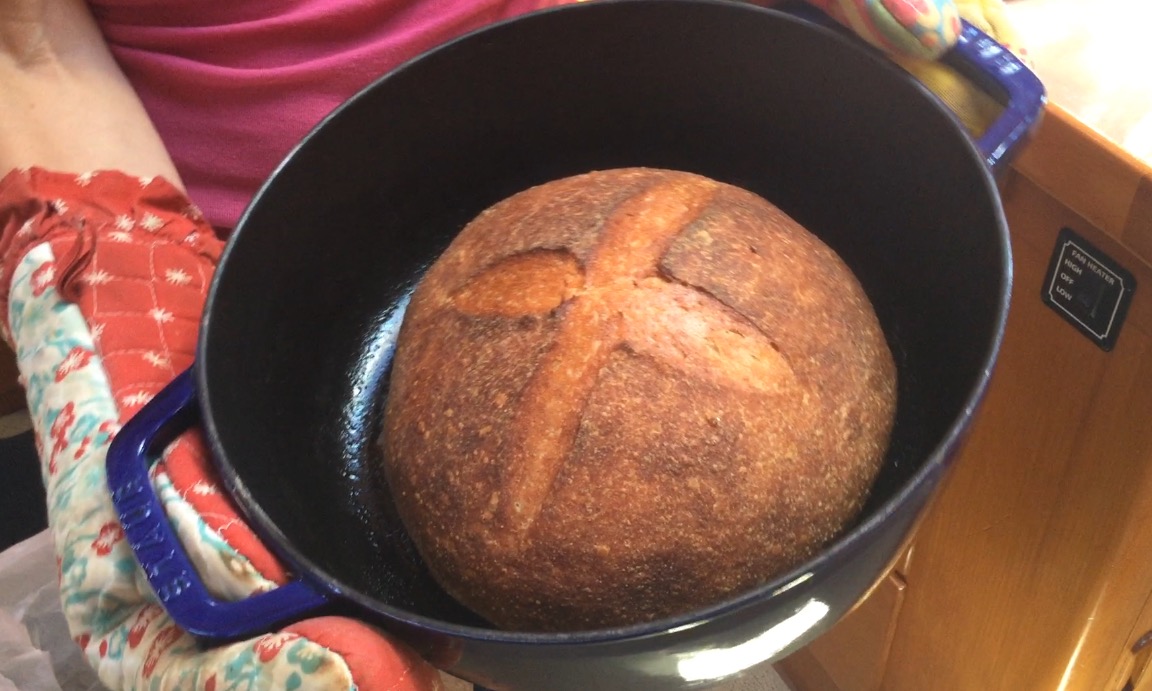
Cooking on a Boat with Kirsten: Episode 3 Rustic Bread
We all know good bread is hard to find while cruising so here's another recipe...
I modified this recipe from the original that appeared in Cook's Illustrated.
INGREDIENTS
2 cups (10 ounces) all-purpose flour
1 cup (5.5 ounces) whole-wheat flour
1 1/2 teaspoons salt
1/4 teaspoon instant or rapid-rise yeast
3/4 cup plus 2 tablespoons water, room temperature
6 tablespoons mild-flavored lager
1 tbsp. honey
Olive oil
INSTRUCTIONS
1. Whisk all-purpose and whole wheat flours, salt, and yeast together in large bowl. Add water, honey and lager. Using rubber spatula, fold mixture, scraping up dry flour from bottom of bowl until shaggy ball forms. Cover bowl with plastic wrap and let sit at room temperature for at least 8 hours or up to 18 hours.
2. Lay 18 by 12-inch sheet of parchment paper on counter and wipe with olive oil. Transfer dough to lightly floured counter and knead 10 to 15 times. Shape dough into ball by pulling edges into middle. Transfer dough, seam side down, to center of parchment and brush with olive oil. Pick up dough by lifting parchment overhang and lower into heavy-bottomed Dutch oven (let any excess parchment hang over pot edge). Cover loosely with plastic and let rise at room temperature until dough has doubled in size and does not readily spring back when poked with finger, about 2 hours.
3. Adjust oven rack to middle position. Remove plastic from pot. Lightly flour top of dough and, using razor blade or sharp knife, make one 6-inch-long, 1/2-inch-deep slit along top of dough. Cover pot and place in oven. Heat oven to 425 degrees. Bake bread for 30 minutes.
4. Remove lid and continue to bake until loaf is deep brown and registers 210 degrees, 20 to 30 minutes longer. Carefully remove bread from pot; transfer to wire rack and let cool completely, about 2 hours.
Thursday, September 3, 2015
Arriving in Barkley Sound
From Hot Springs Cove we headed up inlet to Bacchante Bay where we spent the night in hopes of paddling up the creek there. Unfortunately we were too lazy to wake up early to paddle the high tide in. When we finally made our attempt to paddle upstream, both creek and tide were too low to make any progress. We're not sure if was due to the dry summer or low tide. Probably both. After a quick swim we headed back down inlet to Ahousat to stage for our next hop around the outside. There was nothing notable about the dock at Ahousat except for the pack of dogs who would have liked to have eaten Pika for dinner.
Our next stop was Ucluelet for re-provisioning, laundry, water top-off, fuel and a dinner out. The next morning we squeezed in a lunch of the freshest fish and chips ever (the fisherman who just brought in the salmon we ate was in line in front of us) and a hike on Pacific Wildside Trail while we waited for the tide to turn in our favor.
We spent the afternoon motoring to Pipestem Inlet where we stayed anchored for the next two nights. The following morning we woke to rain. Finally. We had been sailing in the Pacific Northwest for two and a half months and had only seen three days of rain. The landscape finally looked at peace again, draped in low lying clouds and drizzle. Sigh. We suited up in rain gear and climbed into our kayaks for a soggy paddle up beautiful Lucky Creek to a sweet little waterfall.
After two nights in Pipestem Inlet we moved on, through the pouring rain, to a lovely little anchorage at Nettle Island. The rain continued to pour so we opted to not put on our already soaked rain gear to paddle to shore. We stayed on the boat playing board games and reading instead.
The following morning we got a sun break so we laid all our soaked clothing out on the warm decks to try to dry them out before heading out to Joe's Bay at Turtle Island. Our plan was to paddle once in Joe's Bay but the winds were so high and the water so choppy that we were boat bound again. I was starting to get a little stir-crazy at this point....
Click here for photos.
Thursday, August 27, 2015
Hot Springs Cove
After waiting out six days of high winds in Nootka Sound, we finally got the opportunity to make our hop around Estevan Point. We woke up uber-early (for us) and pushed off from the Friendly Cove dock at 5:30am. The sun had just snuck over the horizon and shone unnatural and red through smoke from forest fires burning on Vancouver Island. 90 degree air temp, 78 degree water temp and forest fires on Vancouver Island? Scary. I wolfed down my granola, yogurt and morning tea in hopes that if I ingested them before we hit the swells maybe I wouldn't be sea sick. No such luck. The high winds gave way to a windless, rolly day offshore which gave us an easy, though slightly nauseous, passage. Estevan has a reputation for being rough and causing trouble, so we were happy to get off so easy.
We arrived at Hot Springs Cove before lunchtime and snagged the last spot on a super busy dock. Just two weeks before our arrival an old-fishing-boat-turned-restaurant had opened in the cove, so the kids and Jason were super excited to eat delicious salmon burgers for lunch instead of peanut butter and jelly, yet, again. We really felt like we had re-entered civilization at this point. Hot Springs Cove is an amazing place where hot, sulphury water bubbles up from the ground, picturesquely cascades over a beautiful, but stinky, waterfall and then tumbles into descending pools of various temperatures, depending on the tide level, below. Needless to say, it is a major tourist attraction and there is a constant stream of high-speed tour boats and seaplanes from Tofino shuffling tourists in and out all day long. As a sailboat spending the night the local advice is to wait until after 6pm and you can have the hot springs to yourself. On the first day we decided it would be interesting to see it at its peak... We could easily see it alone later.
After lunch we slipped into our bathing suits and walked the famous boardwalk carved with boat names. It was fun to check them all out along the way and we were excited to see some old dock mates and the Ballard contingent.
It was high tide when we arrived at the hot springs. We weaved our way down through boulders, pools and people and squeezed into a spot at the bottom where the waves pulsed in and out, sucking two delighted, squealing children back and forth. We had a lovely conversation with a Norwegian/Japanese couple from Tokyo where we learned which seaweed floating in the sulphury pool we could dry to make nori. We took a good look, but left these healthy, stinky, tourist infused specimens where we found them.
Back at the dock a crab boat passed by and yelled to see if we wanted any crab....an offer we couldn't refuse. He pulled up to the dock and we bought two Dungeness crabs and the owner of the fishing boat restaurant bought a halibut. We ate the crabs for dinner and then bought the freshest halibut burgers ever for lunch the next day. Yum.
The following day the weather finally cooled down and we spent the day relaxing on the boat and catching up on all things wifi. Jason's work was relieved to find out that we were still alive after so many weeks of silence. In the evening, after all the tour boats had left, we headed back to the hot springs for the solitude experience. A pack of wild half-wolf, half husky pups (who live across the way and swim over to the hot springs dock to beg food from all of the tourists) followed us all the way down the board walk to the hot springs. They were awesome. At the hot springs, we found another couple from the dock tucked into a pool down by the ocean. It was the only pool that was at a bearable temperature at low tide so we squeezed in between rocks nearby and had a nice conversation. Eventually they packed up and left and we had the place to ourselves. We decided to soak Scandinavian style, (no not naked!) alternately dipping in the hot pools and then cold. It was so invigorating. Once we'd had our fill, we walked back through the dusky forest to the dock where we were re-greeted by our new doggy/wolfy friends.
After two lovely nights at Hot Springs Cove, we fired up the engine to continue on our way. At first, all was well, but then the reassuring splooshing sound of water from the back of the boat stopped. Jason shut down the engine and began the process of trouble-shooting why the water intake was no longer working. After some back-and-forths on what we should or should not tear apart, he finally worked the hose loose that I thought he shouldn't and he discovered our problem. A poor little fish had met its maker in our water intake system. Sad. Jason pulled him out, put everything back together and we were on our way.
Click here for photos.
Saturday, August 22, 2015
Cooking on a Boat with Kirsten: Episode 2 Granola Bars
Emma also wanted to learn how to make my homemade granola bars so I made her another video. I halved the recipe in the video. The full recipe follows below.
1 cup natural-style peanut butter
1/4 cup honey
1 1/2 cups dry uncooked old-fashioned oatmeal
1 1/2 cups homemade granola
Your Desired Amount of Dark Chocolate - chopped
Directions:
Mix oats, granola and chocolate together in a large bowl. Add peanut butter and honey and throughly mix. The mixture shouldn't be too sticky or too dry....it needs to be just right. Feel free to add more wet or dry ingredients in order to get the correct consistency
Once desired consistency has been reached, dump mixture onto a cutting board and squeeze into a tight rectangle. Cut into desired size and squeeze them a little lighter. Wrap each bar in foil and store in plastic bags. - No need to refrigerate as the ingredients are natural.
Friday, August 14, 2015
Friendly Cove is Friendly
This is going to sound cheesy, but Friendly Cove definitely lives up to its name. Rich with history, it has been continuously inhabited by the Mowachaht/Muchalaht people for the last 4,000 years and was the first place Europeans touched ground in BC when Captain Cook stopped here to repair his damaged ships in 1778. This lovely spot once housed 1500 First Nations people in 20 long houses. We were happy to tie up to the dock here after a couple of weeks of solitude in more remote country further north. It felt nice to step back into "civilization" here with its five or so inhabitants.
We socialized with the folks across the dock who were waiting for a documentary film crew to join them. As experienced sailors who have sailed the paths described in the logs of Captain Vancouver and Charles Darwin, they were hired to transport a film crew along the path of famed marine biologist Ed Rickets. They spent years sailing in Peru where they met Doug Tompkins, the founder of North Face. He invited them to his house by giving them its lat-long coordinates expecting they'd never be able to find him, but, they did. He was very surprised and greeted them with great hospitality when they sailed into his domain one day.
The following morning Jason started a conversation with a fisherman who lives there. The fisherman showed him how to succeed at salmon fishing and gave him some line and lures for us to drag behind our boat. Jason asked if he could pay him for the equipment to which he replied, "You don't need to, I just like to help people." Jason gave him a little cash anyway and then we headed out for the day.
We explored the church originally built in the 1880's. It burnt to the ground in the 1950's and was rebuilt in 1957 with stain glass windows donated by the Spanish government in remembrance of the 1792 peace negotiations between England's Captain Vancouver and Spain's Captain Quadra. Here we learned about the history of Friendly Cove and of the Whalers Shrine, an ancient site of purification rituals where 16 human skulls, 88 carved human figures and 4 carved whales were found. It was reported to have great powers but all contents were stolen (purchased in shady circumstances) in the mid-1920's and taken to a New York museum where they currently collect dust in the basement. The tribe is working on retrieving the shrine and returning it to its proper home.
We then walked through the forest past an old graveyard filled with Christian crosses to a freshwater lake where we went for a swim. Even Pika swam, though she didn't really have a choice since we plunked her in the water away from shore. While sunning ourselves afterwards, Aaron and I became entranced by all of the round polished rocks on the shore. They were so smooth that they looked like they had been through a rock polisher. Eventually we tore ourselves away from the lake and headed to the beach. We were delighted to find that the beach was entirely made up of these polished rocks in all different sizes and colors. Apparently in the 1700's there was a tidal wave that swept rocks from the beach over the hill and deposited them in the lake. We spent hours on the beach filling our pockets with precious pebbles, rock climbing on the sea-stacks and giving each other rock massages. As we left the beach we startled a couple of guys who had just checked into one of the ramshackle rental cabins off the beach. They were the film crew our dock mates had spoken of and had just flown in from LA. They were totally freaked out about being in such a remote location and were so thankful to see other human beings. It was hilarious to us how different our points of view were. We had just re-entered civilization, and they felt completely isolated and on the edge of the world.
Next stop was the lighthouse where we had a fascinating conversation with the lighthouse keepers. We asked if it got lonely out there. They said in the summer, not-so-much, but in the winter they don't ever see anyone except for the helicopter pilot that drops them supplies every five weeks. They said that the cove goes totally National Geographic in the winter. They have the herring hatches and then the cove fills as everything comes to feed on all the herring...orcas, sea lions, seals, sea otters, whales, etc. We told them about how we had seen three sunfish (and possibly a basking shark?) on our last passage to which they replied that the warming of the water is bringing in all kinds of new fish. A couple of years ago there was an invasion of humboldt squid. People were totally freaked out because they were attacking boats. One fisherman they know had his little aluminum fishing boat completely surrounded and attacked and he thought he was going to die. Come winter time they had hundreds of squid enter the cove and die. Needless to say, it smelled abominably bad. They used a crane to haul some of them up onto the dock where they took photos of the six-foot monsters. They are still using remnants of the squid for bait.
When got back to the boat, we found a bag of food sitting in the cockpit. In surprise I rummaged through the bag and found ziplocks filled with smoked salmon, halibut, shrimp, four carrots and a beet. The fisherman we met in the morning had left us a very generous gift. We were so surprised and super grateful. Our freezer was fully stocked again, a major relief to the person who is constantly worried about where we'll find food next.
The next day we headed up inlet to Moutcha Bay to top off our water tanks. It was uber-hot (90+ degrees) and we spent the day alternately sweating and jumping into the 78 degree water. The water was super floaty so we could just lounge around for long periods of time without getting tired or cold. It felt really, really weird to be experiencing such tropical bliss in this part of the world. We found out later that it was the highest temperatures ever recorded, for any day, for this area.
While tied up at Moutcha with calm weather, we took the opportunity to change our headsail. The tack on our jib had developed a small tear in it and we no longer trusted it to hold. The high winds from our crazed sail had dramatically increased the tear so we dropped the jib and replaced it with our genoa, though we had to swim three times to cool down before the job was done.
After a night at Moutcha we headed back down inlet where we tried out our genoa for the very first time. We were beating into weird, swirly, gusty winds and we discovered right away that we were not fans of the bigger surface area the genoa carries at this wind angle. We had a couple of gusts of 25+ knots which buried the kayak into the water and made me use unlady-like words.
After a brief overnight at St. Gertrudis, we made a quick hop back to Friendly Cove where we would continue to wait out the high winds that were raging offshore. We happily repeated our activities from our previous stay but added a trip to see an old fallen totem. Buried deep in a thicket of blackberries, it was so amazing to see a real totem, gorgeous and magical. When it fell the Royal British Columbia Museum wanted to saw it apart and move it their museum. The tribe declined, believing it is the way of things to let it return to Mother Nature.
Click here for photos.
Subscribe to:
Comments (Atom)